We celebrated Rand’s Birthday by taking an overnight trip to ASA Wright Nature Centre and Lodge. (www.asawright.org). What a fabulous experience!! We recommend this Centre to everyone. We suggest you take advantage of an overnight stay as it not only is quite a ways to travel but we feel one needs to experience the early morning tranquil hours .
We had such a great time and my only dilemma is picking the pictures to share as we took soooooo many.. Jesse picked up Wednesday morning and came back for us around lunch the next day. There was a total of 11 cruisers in our group.
 We broke up the two hour drive stopping at a roadside eatery to try local West Indian food. We really like the doubles. They are very messy to eat but we were amazed that they did not taste greasy. What is a double? A double is made with two baras ,deep fried rounds of thick batter. In between the two baras is curried channa which are ground up chickpeas and then topped with chutneys and sauces. Delicious...
 Now I tried everywhere to find a better picture of this to no avail, so sorry that it is a little fuzzy. This is a Sahenna---made of calaloo bush leaves rolled together, sliced and dipped ina split pease base, then deep fried...We were amazed how good it tasted. The other item Rand tried was a Kechorie which was ground up split pease rolled into a ball with spices and then deep fried.
 This vegetable Christophene is grown off the ground up the hillside (see background) on vines.
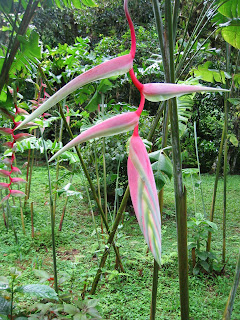
 As we drove through the forest we constantly saw the countries flower----Chaconia. It grows wild in the forest and is bright red.



 Beautiful bright orange tubed shape flower called Kohleria tubiflora had a mass of tiny dots inside each flower.
 The poisonous Trumpet flower was in abundance.
 The oranges here have green skin.
 Impatiens are a natural ground cover here.


 Huge Hibiscus outside our cottage. We also saw a beautiful coral shade.
 Our cottage for the night was half a duplex with a protected verandah.
 I think if you click on pictures you hopefully will get to see the birds a bit better. Not technically being birders but always enjoying them at home I think we now have a new hobby. We have decided we definitely need a better camera so we can zoom in on these beautiful creatures.
 Green Honeycreeper. Dazzling colour.

 This yellow tailed-crested oropendola is regarded as a pest as it is quite aggressive; but it sure has a beautiful bright yellow tail seen in flight.


 Aug. 28th. Thanks to Donna and Barry waking us up at 0600hrs. we enjoyed watching the forest awake.


 Strategically placed dead trees for our benefit.


 Hummingbird


 Isaac explains we will not see the Oilbird today as they live up on the ledges of caves. We could hear them though---- a very loud clicking sound. Isaac tells us the Oilbirds wing span is 3 feet. As babies the Oilbird grows to twice the adult weight feeding on the oil rich fruits of the forest which makes them very fat. Years ago they were captured and their fat boiled for torch oil. (I pulled this picture off the internet.)


We had such a great time and my only dilemma is picking the pictures to share as we took soooooo many.. Jesse picked up Wednesday morning and came back for us around lunch the next day. There was a total of 11 cruisers in our group.
 We broke up the two hour drive stopping at a roadside eatery to try local West Indian food. We really like the doubles. They are very messy to eat but we were amazed that they did not taste greasy. What is a double? A double is made with two baras ,deep fried rounds of thick batter. In between the two baras is curried channa which are ground up chickpeas and then topped with chutneys and sauces. Delicious...
 Now I tried everywhere to find a better picture of this to no avail, so sorry that it is a little fuzzy. This is a Sahenna---made of calaloo bush leaves rolled together, sliced and dipped ina split pease base, then deep fried...We were amazed how good it tasted. The other item Rand tried was a Kechorie which was ground up split pease rolled into a ball with spices and then deep fried.
Again these items deep not taste greasy. One would of thought they were baked.
Randy and Jesse "horsing" around.
 This vegetable Christophene is grown off the ground up the hillside (see background) on vines.
  As we drove through the forest we constantly saw the countries flower----Chaconia. It grows wild in the forest and is bright red.
ASA is a 200 acre conservation Wildlife Sanctuary 1200 feet above sea level in the rain forest of North Trinidad. Originally a coffee and cocoa plantation owned by ASA Wright and her husband in the late 1800's early 1900's. An amazing fact about ASA herself was she was born and raised in Iceland.
The property became a nature centre in 1967.

The 26 room lodge is comprised of mainly cottages. The main house built in 1908 is where we enjoyed meals and the verandah for our best view of the birds.

After the long drive we were ready for a short hike before "High Tea" was served.

 Beautiful bright orange tubed shape flower called Kohleria tubiflora had a mass of tiny dots inside each flower.
 The poisonous Trumpet flower was in abundance.
 The oranges here have green skin.
 Impatiens are a natural ground cover here.
One of the many streams we came across.


 Huge Hibiscus outside our cottage. We also saw a beautiful coral shade.
 Our cottage for the night was half a duplex with a protected verandah.
 I think if you click on pictures you hopefully will get to see the birds a bit better. Not technically being birders but always enjoying them at home I think we now have a new hobby. We have decided we definitely need a better camera so we can zoom in on these beautiful creatures.
 Green Honeycreeper. Dazzling colour.
A Hummer up at the feeder with the Bananaquit enjoying the feast on the table.
 This yellow tailed-crested oropendola is regarded as a pest as it is quite aggressive; but it sure has a beautiful bright yellow tail seen in flight.
This good size animal is an Agouti and is a type of rodent. It in fact is a very important member of the rain forest foraging for fruits and nuts.


Ending our day in the great company of Donna and Barry (S/V Sea Star eh!)
 Aug. 28th. Thanks to Donna and Barry waking us up at 0600hrs. we enjoyed watching the forest awake.

We had no luck with hummers coming close to the verandah, however, the Bananaquit was very inquisitive.
 Strategically placed dead trees for our benefit.

See the birds nest hanging by the 4x4. We saw these hanging out in the forest.

Priviledged to see the MOT MOT
 Hummingbird
After breakfast we went on a two hour hike on a couple of the rain forest trails. Even with bug spray we still had bugs swarming around us.


Isaac is our guide for our hike. He is very knowledgeable sharing facts on the fauna, insects, Oilbird and the famous Bearded Bellbird.
Isaac explains we will not see the Oilbird today as they live up on the ledges of caves. We could hear them though---- a very loud clicking sound. Isaac tells us the Oilbirds wing span is 3 feet. As babies the Oilbird grows to twice the adult weight feeding on the oil rich fruits of the forest which makes them very fat. Years ago they were captured and their fat boiled for torch oil. (I pulled this picture off the internet.)
Making the nature walk totally worth while was seeing the Bearded Bellbird. (I had to pull this pic off the internet too.) What an amazing bird. We literally had to hunt for it. First we heard its cry.....a very slow loud hammering like someone hitting a piece of steel and then the sounds gets quicker and quicker....this is how he calls for a mate. Following the sound sure enough Isaac found one high up in a tree. It started to jump on the branch in excitement.

While watching the Bellbird Barry noticed this bug on the underside of a huge leaf right over Donna's shoulder.

Back at the lodge we saw one of these feeding on the bread by the bird stands.. It is a Gold Tegu Lizard. "Tiger Lizard".
Well hope you enjoyed the pics as much as we enjoyed the adventure.


 Tony showed us how he stretches the steel with his hammer and then marks and shape the notes on the surface. The larger the oval the lower the tone. After tempering the notes are softened and tuned. The process will probably take a week. A steelpan will need to be tuned once or twice a year.


 We arrive at Maracas Beach for the famous Shark & Bake. We were told Maracas Beach is where this local dish started. The beach itself was named after a popular instrument used in Trinidadian “Parang” music called the marac a xylophone-like instrument. Parang music is usually heard at Christmas. We went on this trip with Donna & Barry (S/V SEA STAR EH!)


